
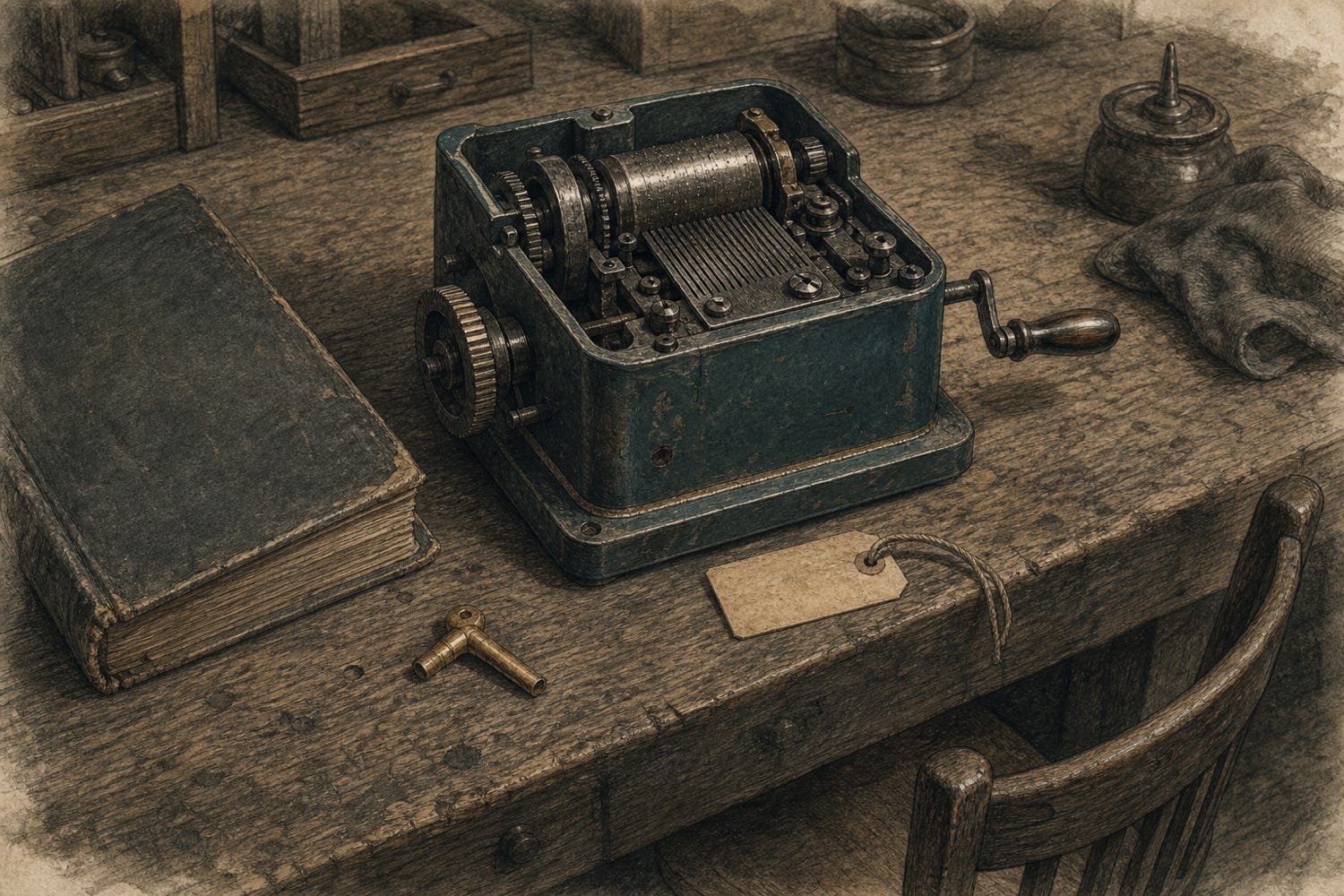
The room at the center of this essay is not a clean design object. It has music, tools, books, notes, screens, small machines, and a few artifacts attached to questions not yet fully formed. It is not minimalist. It is legible. That distinction matters because the room gives one kind of work its ideal conditions: unresolved possibility becoming form.
The claim is that building and running are close enough to confuse and different enough to punish the confusion. Building turns possibility into form. Running begins after the thing stands long enough for people to gather around it. At that point the work changes species. It stops being primarily authorship and becomes constituency.
That shift is visible in boring artifacts: a public sentence, a redline, a signature block, a governance clause, a calendar obligation, an allocation rule before school. These are not the pleasures of ignition. They are the containers a real thing starts needing once other people can depend on it, misunderstand it, be disappointed by it, or pay for its ambiguity.
The pressure point is that the builder’s attractive self has a shadow. The ability to clarify, structure, and solve can become control when it crosses into another person’s tempo. A household dispute is not a product surface. A successor is not a compiler. A company, a book, or a family system does not become less real because it starts requiring patience after the interesting part has cooled.
The counterclaim deserves respect. Stewardship is not merely the dull residue of creation. Sometimes it is the more mature art. It asks for care after novelty, repetition without discovery, and protection from the builder’s own velocity. It asks the maker to keep faith with the thing after it becomes someone else’s job, risk, identity, or ordinary day.
The boundary is not that building is bad and maintenance is noble. The clean reversal would be another flattering story. Some work really is ignition. Some work really does need descent, intensity, and closed-door attention. The mistake is trying to make stewardship feel like building, or treating people as defective systems because they do not answer back like code.
Read the full essay on lospino.so: After the Thing Stands
Original essay published on lospino.so on 2026-05-31. This Substack dispatch is an adapted pointer to the canonical version, not a mirrored copy.