
A clean decoded table is a dangerous object.
Not because the table is wrong. Because it looks finished.
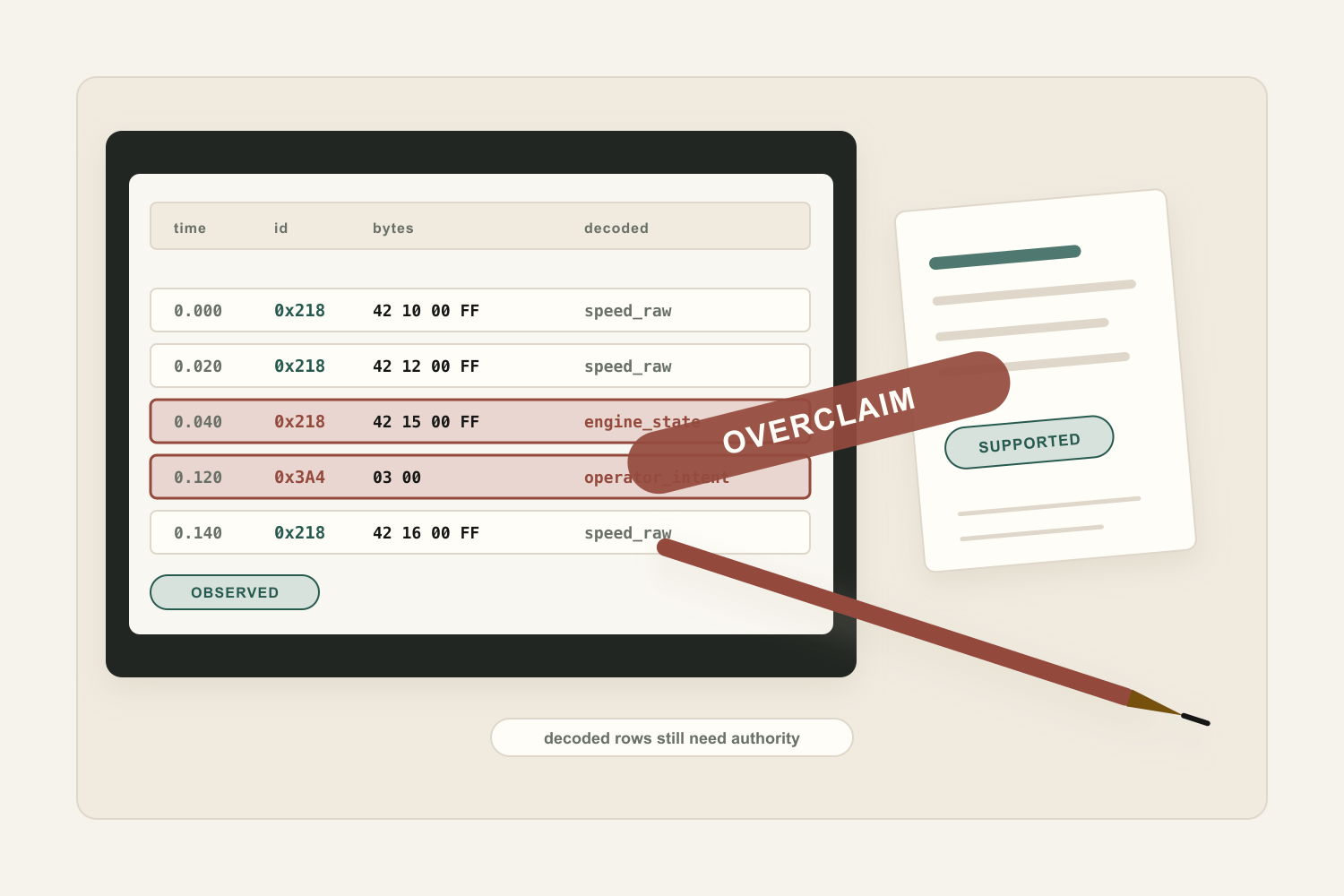
Once a capture becomes rows and fields, the reader starts granting it more authority than it earned. A byte gets a label. A timing gap gets a name. A recurring identifier starts to feel like an identity. A dashboard cell starts to sound like application truth.
That is the failure mode this series is about.
Reading machine buses is not mainly about memorizing protocol trivia. It is about refusing to let an artifact carry a stronger claim than the observation supports.
The move is simple:
Observed artifact. Framing rule. Authority source. Observer boundary. Supported claim. Unsupported stronger claim.
That ladder is easy to say and hard to practice, because the artifact keeps trying to flatten it.
A passive trace can show that something appeared on a wire. It does not automatically show who meant it, what the system believed, what the operator saw, or what the application layer decided. A decoded field can show that a rule was applied. It does not make that rule ground truth. A recurring identifier can support recurrence. It does not, by itself, prove sender identity. A field map can add authority. It can also hide provenance if the reader stops asking where the names came from. A timing gap can be part of the evidence. It can also tempt the reader into treating silence as intent. A role-rich transaction can feel semantically complete. It still remains inside the authority that named the roles.
This matters outside buses. The same error appears in logs, traces, packet captures, diagnostic tables, reverse-engineered formats, observability dashboards, incident timelines, and vendor tools. Clean artifacts create clean stories. Clean stories are where evidence quietly gets promoted.
The point is not to distrust every decoder or table. The point is to read them with a boundary. What did we actually observe? What rule turned the observation into this representation? Who or what gave that rule authority? Where was the observer standing? What claim is supported? What stronger claim is being smuggled in because the artifact looks official?
The examples here are synthetic, passive, and offline. They do not involve live-bus access, replay, injection, scanning, polling, write paths, or control workflows. That boundary is not a side note. It is part of the argument: even safe, static artifacts can still exceed their evidentiary authority if the reader stops separating observation from interpretation.
The canonical series collects the mechanism, examples, and reader discipline in one place.
Read it if your work puts you near machines, captures, logs, decoders, diagnostic output, or any table that looks more certain than it has earned.